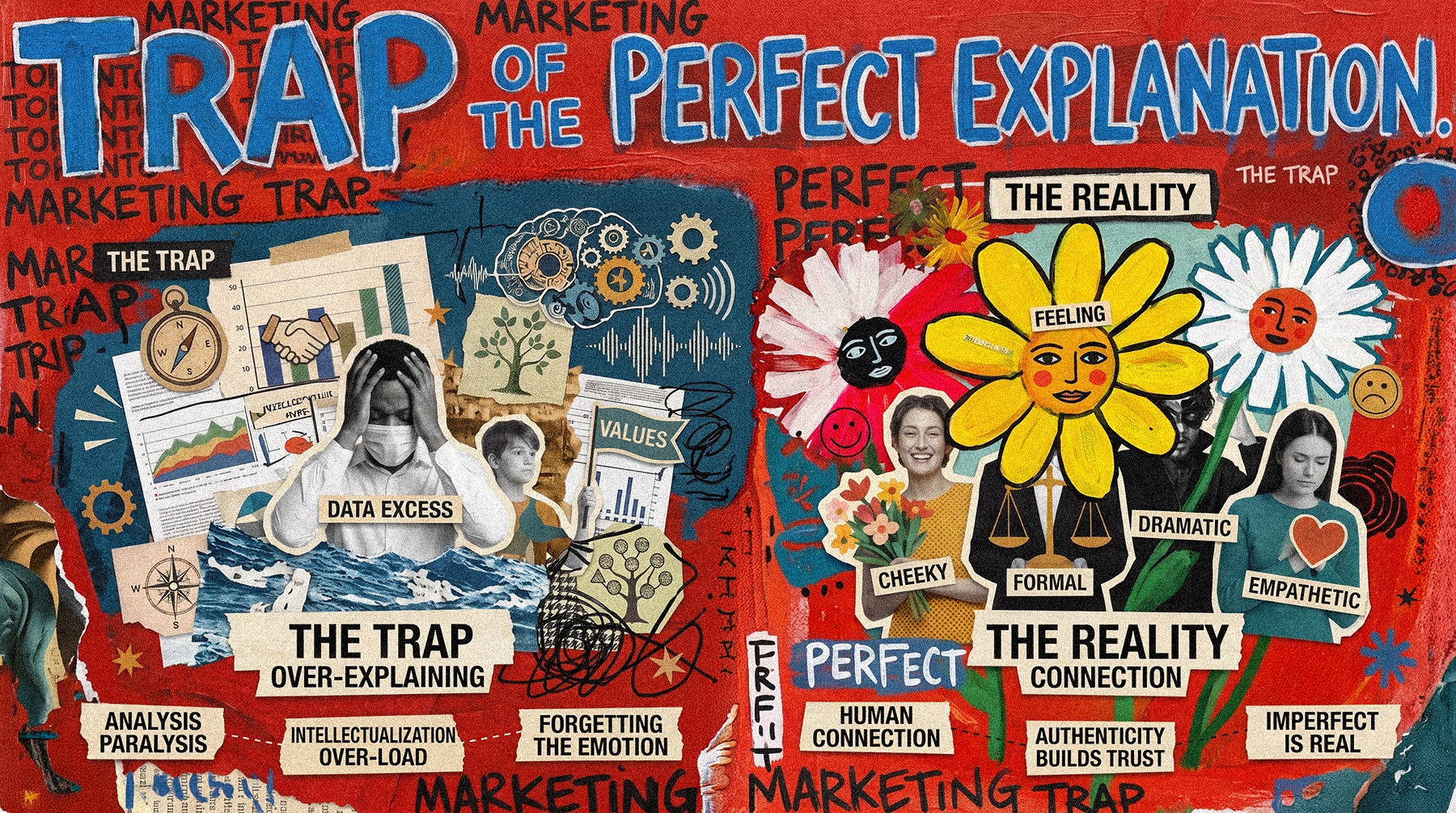
The Trap of the Perfect Explanation
The EDGE – are you connecting emotionally
The Trap of the Perfect Explanation
If they can repeat your pitch word for word, you’ve already lost them.
Ask someone what your company does. They repeat your exact words back. Congratulations — your marketing just failed.
This sounds backwards. Shouldn’t a perfect echo mean the message landed? Not quite. It means the words landed. The meaning never did.
The Difference Between Hearing and Understanding
When someone truly understands what you do, they don’t quote you. Instead, they translate you. They reach for their own words, their own comparisons, their own reasons why it matters to them. The explanation becomes theirs, not yours.
A verbatim repeat means something else entirely. It means your sentence got stored, not processed. It sat in short-term memory like a phone number, ready to be recited but never connected to anything real in their life. As a result, it evaporates the moment they stop needing it.
Consequently, this is why so many pitches feel successful in the room and useless outside it. The prospect nods. They repeat your tagline back correctly. Everyone feels good. Then they leave, and within a day, the message is gone, because it was never theirs to keep.
Two Different Jobs, One Confused Strategy
Marketing actually has two separate jobs, and businesses often blur them together.
The first job is explaining. This is where you transfer information: what you do, who it’s for, why it’s different. Explaining is easy to test and, unfortunately, easy to fail without noticing. People can nod, repeat your line, and still walk away with zero real connection to it.
The second job is landing. Landing means creating a hook that the listener’s own mind grabs and reshapes. It’s harder to pull off, and harder to measure in the moment. But it’s the version that actually produces referrals, brand recall, and buying decisions — because now the idea lives inside their framework, not just inside your script.
Here’s the trap: most businesses optimize entirely for the first job. They polish the explanation until it’s crisp, clear, and quotable. Then they wonder why nobody remembers it a week later.
A Useful Exception Worth Naming
Before going further, it’s worth flagging where this rule doesn’t apply. Taglines and brand names are the exception, not the rule. You genuinely want someone to repeat “Just Do It” exactly as written. Verbatim recall of a slogan is success. Verbatim recall of your value proposition is failure.
The difference comes down to what you’re actually asking for. A slogan is a compressed identity marker — a flag, not an argument. A value proposition, on the other hand, is supposed to create understanding. So the sharper version of the paradox looks like this: if you ask someone to explain what you do and they can only echo your sentence structure, that’s a warning sign. If you ask them to recite your slogan and they nail it, that’s the goal working exactly as intended.
Same test. Opposite meaning. The context is everything.
Why This Happens So Often
Most explanations get built for accuracy, not for stickiness. Teams sit in a room and negotiate the most precise possible sentence. Every word gets chosen for correctness. Nothing gets chosen for how it lives in someone else’s head.
As a result, the sentence becomes airtight and forgettable at the same time. It survives internal review. It doesn’t survive contact with a real conversation three days later, when someone tries to explain your business to a friend and can’t quite remember the wording, so they say nothing at all.
Meanwhile, the businesses people actually talk about tend to have messier, looser descriptions floating around. That messiness isn’t a flaw. It’s evidence the idea got picked up, carried, and reshaped by someone else’s mind. That’s the whole point.
What Landing Actually Looks Like
So what does a message that lands actually sound like, once it’s out of your hands?
It sounds different every time. One person calls it “the company that does the thing with the packaging.” Another says “you know, the ones who actually explain their process instead of hiding it.” Neither sentence matches your internal messaging deck. Both mean the idea worked.
Therefore, the goal isn’t a perfect sentence. The goal is a sticky idea, loose enough to survive translation, sharp enough to survive simplification. If your explanation can only survive as an exact quote, it’s too fragile to spread on its own.
Testing Your Own Marketing
Here’s a simple test. Explain your company to someone new. Then, a few days later, ask them to explain it back to a third person, without you in the room.
If they recite your sentence, something’s off. If they mangle it, simplify it, or reframe it in their own words while still capturing the core idea, it worked. The mangled version is the win. The clean quote is the warning sign.
Additionally, pay attention to which parts they keep and which parts they drop. Whatever survives the retelling is your real message. Everything else was decoration.
The Principle Behind LDJ
This paradox sits at the center of how LDJ approaches marketing. The goal was never to write a sentence people could recite. The goal is to build an idea people can carry, reshape, and pass along in their own words, because that’s the only version of a message that actually spreads.
Perfect recall is a symptom of failure, not proof of success. Real understanding is messier, looser, and far more durable than any polished sentence could ever be.
Ready to find out if you have a ‘perfect explanation’? Visit our Contact page, tell us about your project, and let’s build something worth remembering.